
The Story
The Paths
Not installed through ritual. Not invoked through mantra. Present because he chose to be.
In the Vaishnava tradition, the deity of a temple is usually brought into the murti through prana pratishtha — the rite of life-installation. Priests recite the mantras, offer the sacred threads, invite Vishnu to inhabit the carved form. The murti becomes divine because the community invites divinity into it.
Svayam-vyakta kshetra-s are the exception to this rule. The term — from svayam (by oneself) and vyakta (manifest) — names a small number of places in the Hindu canon where Vishnu appears not because he was invited, but because he chose to. No consecration rite is required. No mantra makes him present. He is already here, by his own will, at a ground he selected.
For a tradition that places such weight on the correct performance of ritual, this is an astonishing category. It acknowledges that the deity's presence is not dependent on human action. There are places where Vishnu simply is — before the priest arrives, after the priest leaves, whether or not any ritual has ever been performed. The place holds the presence. The ritual only registers what was already true.
The shastra-s name eight such places. The Tirtha-khanda and the Divya-desha literature enumerate them. Seven are scattered across the subcontinent. One lies beyond the subcontinent entirely — beyond Bharat-varsha — high in the Himalaya, at the foot of Dhaulagiri. That one is Mukti Kshetra. It is the only svayam-vyakta kshetra outside India. It is the only one in the Himalaya.
The traditional enumeration of svayam-vyakta kshetra-s varies slightly across sources, but the mainstream list holds the same form.
Srirangam, in Tamil Nadu — the great island temple of Ranganatha reclining on Adi-shesha, the foremost of the Divya Desam-s. Srimushnam, also in Tamil Nadu — where Vishnu appeared as Bhu-varaha, lifting the earth from the waters. Tirupati, at Tirumala — Venkateshvara, the form in which Vishnu is said to remain present through the Kali Yuga. Naimisharanya, in the Gomti basin — the forest where the rishis assembled and the Puranas themselves were first recited. Totadri — Vanamamalai, the jungle temple of Varaha. Pushkar, in Rajasthan — the lake-temple sacred also to Brahma, where Vishnu is present as Varaha. Badrinath, in the Garhwal Himalaya — the seat of Nara-Narayana.
And the eighth: Mukti Kshetra — Pulhashram Muktinath — on the banks of the Kali Gandaki. The only one outside the bounds of Bharat-varsha. The only one at altitude. The northernmost. The one that Swaminarayan, through Nilkanth Varni, chose for his deepest tapasya.
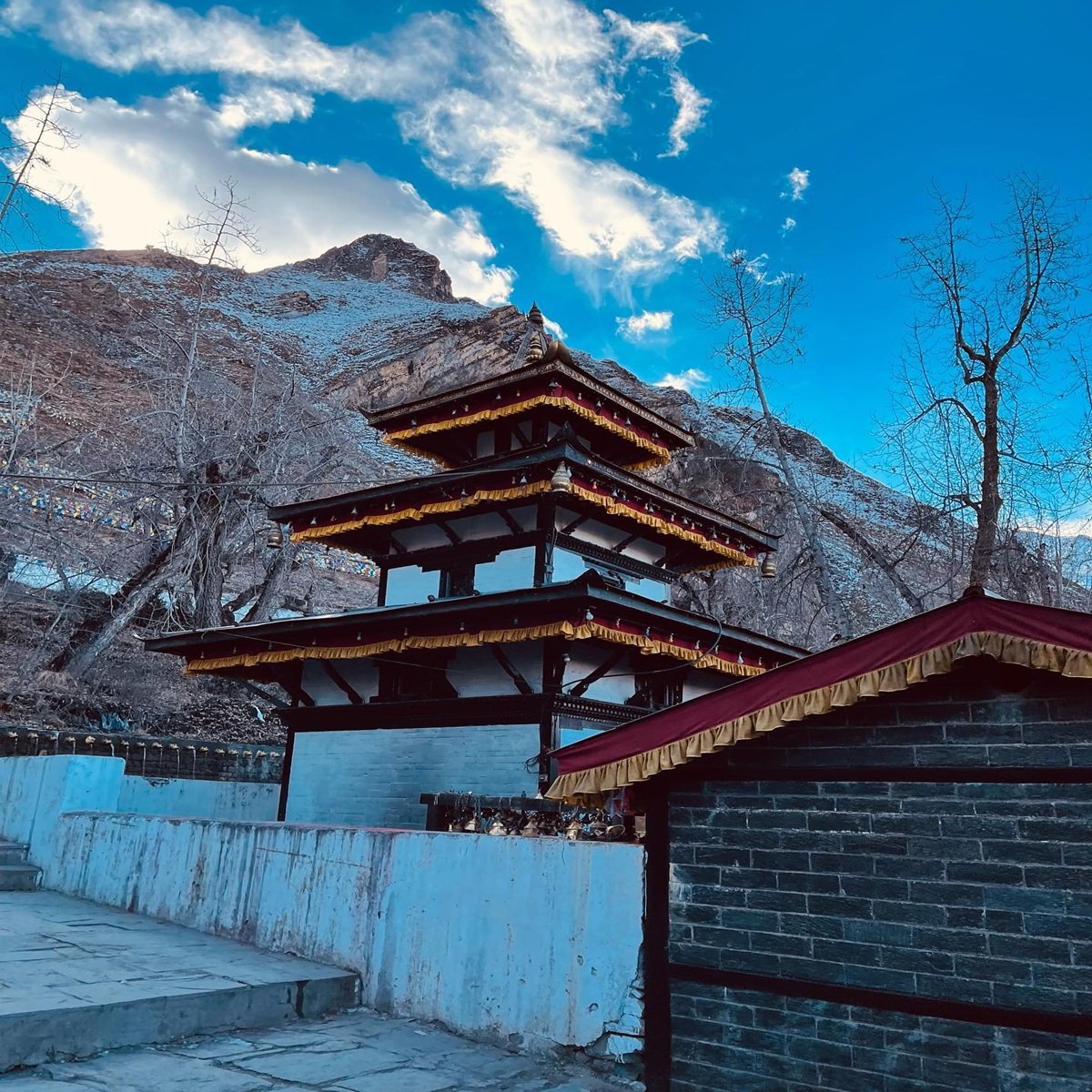
Between the sixth and ninth centuries, the Tamil Alvars — a lineage of twelve poet-saints who composed the Nalayira Divya Prabandham, the four thousand sacred songs of Sri Vaishnavism — identified a hundred and eight temples as Divya Desam-s: the supreme abodes of Vishnu. Each Alvar sang of the places he had visited or received darshan of. Between them, the hundred and eight were fixed in the canon.
Of those hundred and eight Divya Desam-s, one hundred and six lie within the subcontinent. One is called Vaikuntha — the celestial abode, beyond worldly geography. And one, alone, lies in the earthly world but beyond the bounds of Bharat-varsha. The Alvars named it Thiru Saligramam — the Saligramam of Lord. It is Mukti Kshetra. It is Pulhashram.
A thousand years before Nilkanth Varni walked to this ground, the Alvars had already sung of it. They had composed hymns to the Vishnu present here. They had named him — by name — Mukti Nath, the Lord of Liberation. The name the temple carries is not invented by pilgrims. It is the name the Alvars used. It has been in unbroken usage, in south Indian Vaishnava prayer, for longer than the Swaminarayan sampraday has existed.
When a satsangi arrives at Muktinath, they are not discovering a shrine. They are arriving at a place whose consecration in Vaishnava memory is already a millennium old.
Inside the Mukti Kshetra temple complex is a small natural chamber. In it, Vishnu's self-manifestation is not represented. It is visible.
The chamber is called Jwala Mai — the Mother Flame. From fissures in the rock of the chamber floor, natural gas seeps continuously. The gas ignites, and the flames burn without pause, without fuel, without tending. Above them, a thin stream of water flows out of the stone — perpetual, cold, glacial. The flame does not extinguish the water. The water does not extinguish the flame. Both come from the earth. Both persist.
For the shastra-ic imagination, this is the phenomenon. The svayam-vyakta principle is made visible here in its purest form. Fire, water, and earth are not separate, do not cancel one another, and do not require a priest's mediation. Vishnu manifests as the sustaining witness of that impossibility. In the chamber above Jwala Mai, the ordinary laws of the four elements break down in silence. What the Puranas describe in the abstract — a ground where Vishnu is present by his own will, before any rite, beyond any ritual — the Jwala Mai demonstrates by continuing to burn.
Outside the main shrine, a hundred and eight stone spouts — the 108 Mukti Dhara — pour ice-cold water from the glacial feed above. Pilgrims walk beneath every one. The completion of the passage under all 108 is understood, in the Swaminarayan sampraday and in the wider Vaishnava tradition alike, as the bodily mark of moksha-krida: the play of liberation. The elements themselves — the very water of this altitude — are the tools of the liberation the place is named for.
Add the wind, which at 3,710 metres is the thinness of prana itself, and the open sky overhead. All five elements — panchabhuta — are present, separable, visible, legible. Mukti Kshetra is the one place where the physics of the cosmos and the metaphysics of Vishnu occupy the same square metre of stone.
Shaligram, Tapo Bhoomi, and Svayam-Vyakta. Three arguments. One place.
Every major Vaishnava tirtha holds one of these threads. Srirangam is svayam-vyakta, but the Kaveri does not carry Shaligram. Badrinath is svayam-vyakta and a tap-bhoomi of rishis, but again, no Shaligram. The Kali Gandaki corridor is the one place where all three arguments converge on a single stretch of ground. A river older than the mountains, carrying Vishnu's aniconic self-form in its sediment. A tap-bhoomi held by Pulaha and Bharat before the Puranas were written down. A svayam-vyakta kshetra named by the Alvars a thousand years ago, where the five elements demonstrate the principle of self-manifestation by burning, flowing, and standing still in the same chamber.
For Nilkanth Varni, carrying his Bal Mukund Shaligram across twelve thousand kilometres of van vicharan, reading the Puranas open in his hand, trained in the full Vaishnava canon — this was not a difficult choice. This was the only choice. Every argument for where to perform the deepest tapasya of his life pointed to this one ground. When he arrived at Pulhashram and stood in tap-mudra on the banks of the Kali Gandaki, he was not selecting a place. He was completing a convergence the Puranas had described long before he was born.
The Bodha Retreat mission rests on this single observation. We are not introducing a sacred geography. We are returning to one the tradition already placed at its centre — and which, across the last two centuries, the noise of modernity has let slip from the foreground of the bhaktas' memory. The ground was, and remains, here.