The Story
The Paths
Scholar of the Kali Gandaki sacred corridor. Three decades of field research. Member of the Nepal-side committee that identified and authenticated the Ayodhya Dev Shila-s.
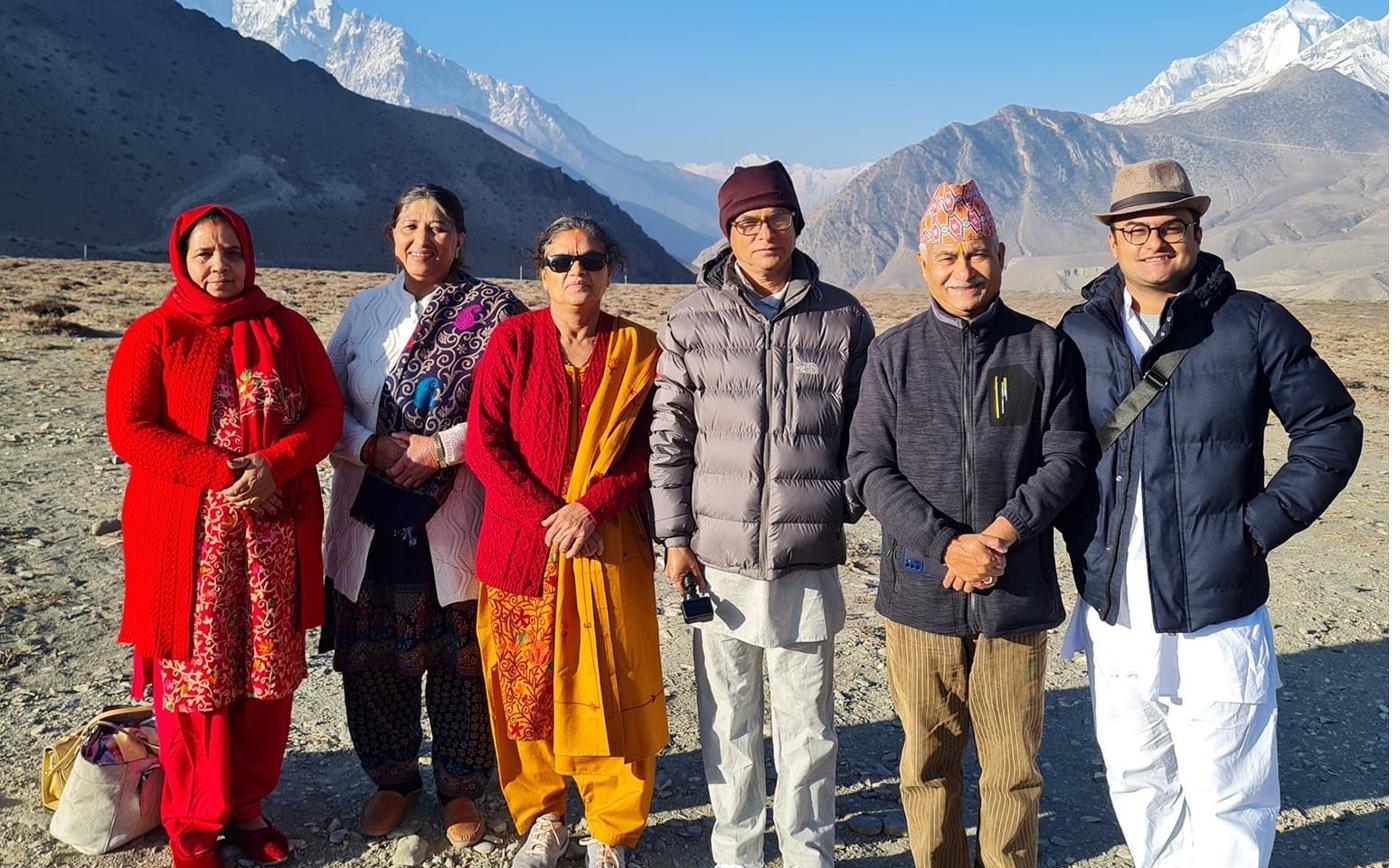
Dr. Kul Raj Chalise was born in the region of Muktinath. His family has lived on and around this ground for generations — not as pilgrims passing through, but as locals of the place itself. His scholarly work began in the 1990s and has continued, without interruption, for more than three decades.
The substance of that work is simple to state and difficult to accomplish. He has walked the Kali Gandaki corridor continuously — from Jomsom to Muktinath, from Galeshwor to Damodar Kunda — reading the Puranic references aloud at the grounds they describe, comparing the sites named in the Bhagavata and the Satsangi Jeevan to the living geography, noting what matches and what requires reinterpretation. He has published articles in scholarly and popular press in Nepali, Hindi, and English. He has taught seminars for sampraday leaders, university departments, and governmental committees.
His central argument, across the whole body of work, is the one this website rests on: the Kali Gandaki corridor is the most significant Vaishnava tirtha outside India, and its prominence in the Puranic canon is out of proportion to the attention it receives in the modern Hindu world. The aim of his scholarship is to close that gap.
Dr. Chalise's role in the Ayodhya stone debate is the credential most often mentioned — and most often misunderstood. Here is the full account.
In early 2023, the Shri Ram Janmabhoomi Teerth Kshetra Trust, in coordination with Nepali religious and governmental institutions, arranged for two enormous ancient stones to be taken from the Kali Gandaki region to Ayodhya. The stones weighed approximately eighteen tonnes and twelve tonnes. They were received at Ayodhya in February 2023 with processions that drew national coverage.
Before the stones left Nepal, they were reviewed and authenticated by a committee of scholars on the Nepali side. Dr. Chalise served on that committee. His role was to confirm the origin of the stones within the Kali Gandaki geological system, to verify their theological significance under the shastra-s, and to provide the scholarly basis on which the Government of Nepal could release them for transport to Ayodhya.
In the months that followed, the Indian media widely described the stones as "Shaligram shila-s." This was a significant misidentification. The stones were Dev Shila-s — sacred stones of the sacred river, ancient, worthy of full honour, and drawn from the one river on earth that carries Shaligram. But they did not bear the chakra-marks that define a Shaligram in the canonical sense. They were not, themselves, svayam-vyakta forms of Vishnu. They were a different category of sacred stone.
Dr. Chalise clarified this in the Nepali and Indian media. He spoke to reporters, gave interviews, and wrote on the distinction — patiently, across many outlets, over many months. The clarification mattered: a national theological debate was already underway about whether Shaligram could be carved. If the stones were Shaligram, the debate had one shape. If the stones were Dev Shila, the debate had another shape entirely. Dr. Chalise was the scholar who named what category the stones actually belonged to. The national conversation shifted around that clarification.
The debate concluded in January 2024 with the Trust's decision to carve the Ram Lalla murti from Krishna Shila — a three-billion-year-old black schist from Karnataka, sculpted by Arun Yogiraj. The Dev Shila-s from the Kali Gandaki were installed at Ayodhya with full honours, uncarved. The theological principle held: what is svayam-vyakta cannot be re-made, and what is Dev Shila must be honoured in its own proper form. On 22 January, the consecration took place.
The downstream effect — for the Kali Gandaki, for Mukti Kshetra, for the Vaishnava tradition as a whole — was the most significant surge of global Hindu attention to this corridor in living memory. It is, in large part, the reason Bodha Retreat exists now rather than a decade from now.
The Chalise family are Nepali. They are not members of the Swaminarayan sampraday. They are not Gujarati; they are not Indian. They are locals of the Muktinath region — their home ground is the ground the Swaminarayan tradition and the broader Vaishnava canon hold as a maha tirtha.
This is the structural fact at the heart of the Bodha Retreat project. It would be unusual for a Swaminarayan scholar to devote three decades to Muktinath; the sampraday has many urgent calls on its scholarship closer to home. It would be unusual for a Gujarati guide to bring their own lifelong knowledge of the Kali Gandaki's geology and Puranic references to a yatra; the corridor is not their native ground. Dr. Chalise is a scholar who has dedicated his lifetime to a place his family has lived in for generations — and whose significance happens to be central to the Swaminarayan sampraday's own scripture.
This is what family of the place means, and why it matters. When a satsangi family arrives at Muktinath under Dr. Chalise's guidance, they are being received not by a tour operator but by someone whose entire life and scholarship has been given to the ground they have come to see.
Dr. Chalise's son, Anup Raj Chalise, is the co-founder of Bodha Retreat and carries the project's public-facing and operational work. The partnership is deliberate. Dr. Chalise's scholarship is the source; Anup's work is to bring that scholarship into forms the wider community can engage with — articles, films, the small yatras, the conversations with families who are considering the journey.
The project's three paths — Gyan, Katha, Yatra — correspond to this division. Gyan is the scholarship, rooted in Dr. Chalise's decades of research. Katha is the storytelling, the transmission of that scholarship through film, recording, and narrative, work that Anup leads. Yatra is the physical pilgrimage, led by Dr. Chalise personally. Together, the two of them — father and son — pursue one aim: bringing the memory of Mukti Kshetra back into the living awareness of the bhaktas of Bhagwan, and of the wider Hindu community.